
What does a small business website cost? It’s the first question almost everyone asks us, and it’s a fair one. The honest answer is that it depends — but “it depends” isn’t useful unless you know what it depends on. Here’s how website pricing actually works, so you can read any quote with confidence.
The short answer
For most local businesses, a professionally built website is a one-time project cost plus a smaller monthly cost to keep it hosted and maintained. Across the industry, a straightforward site for a small business usually lands somewhere in the low-to-mid four figures. Sites with online booking, stores, lots of custom content, or connections to other software cost more.
Anyone who gives you a firm number before asking about your business is guessing. A good quote starts with questions.
Free website planner
The fastest way to keep a website quote down is to show up with your pages and content planned. Our free planner walks you through it. Get the free planner.
What actually drives the price
Five things account for most of the difference between a modest quote and a large one:
- Number of pages. A five-page site is a very different project from a thirty-page site with a page for every service and every town you serve.
- Who writes the content. Writing is the most underestimated part of a website. It’s also the biggest reason a site brings in calls. If the web company writes it, that’s real work and it should be in the quote.
- Custom design or a template. A template is faster and cheaper up front. A custom design fits your business instead of forcing your business to fit the template.
- Features. Booking, online payments, stores, member areas, and forms that feed your customer software all add build time.
- Moving an existing site. Migrating content and protecting the Google rankings you already have takes careful work: redirects, checks, and testing after launch.
The costs after launch
A website isn’t a one-time purchase any more than a truck is. Budget for:
- A domain name, usually a small yearly fee.
- Hosting, which is where your site lives. Cheap hosting is tempting, but slow sites lose customers and rank lower.
- Updates and security. Website software needs regular updates, or sites break and get hacked.
- Content changes like new photos, hours, services, and staff.
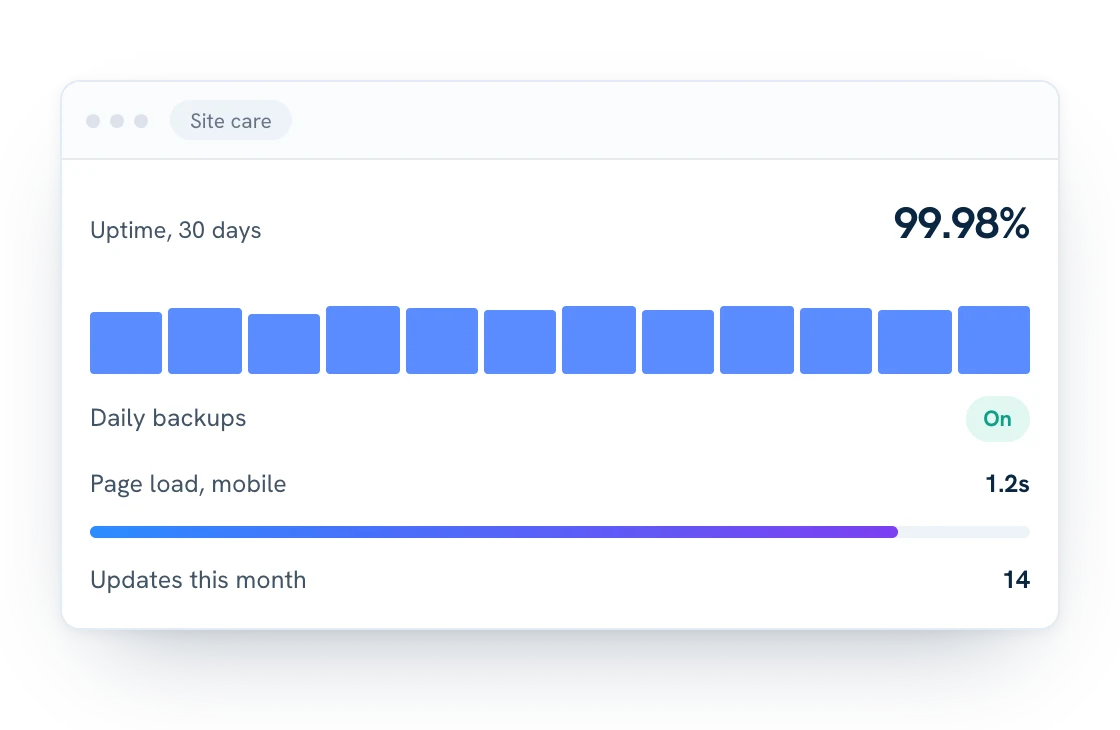
This is what a care plan covers. Ours bundles hosting, updates, daily backups, monitoring, and small edits into one monthly cost, so there’s no surprise bill when something needs attention.
Red flags in a website quote
- No questions asked. If they priced it without learning what your business does, the site won’t be built around your business either.
- A rock-bottom price with “unlimited revisions.” This usually means a template with your logo dropped in.
- You don’t own the site. Ask plainly: if we part ways, do I keep my website and my domain? The answer should be yes.
- Open-ended hourly billing. Hourly work is fine for small changes. For a full build, you should know the total before you start.
- No plan for after launch. Who updates it? Who fixes it? Who do you call?
One question worth asking any web company
“What happens when something breaks at 9 p.m. on a Friday?” The answer tells you a lot.
How we quote
We start with a short conversation about your business and what you need the site to do. Then we give you a fixed quote before any work starts: the full price, up front, with a clear timeline. If the scope changes, we talk about it before anything changes on your invoice.
If you’d like a number for your project, tell us about your business and we’ll get back to you within one business day.